


A main purpose of the Canada Border Services Agency (the “CBSA“) is to determine whether people are inadmissible to Canada and, if they are, next steps. Section 15(1) of Canada’s Immigration and Refugee Protection Act (the “IRPA“), read in conjunction with r. 28(b) of Canada’s Immigration and Refugee Protection Regulations (the “IRPA”) authorizes Border Services Officers (“BSOs“) to examine people who are entering Canada to determine their admissibility. As well, IRPA s. 18(1) provides that every person seeking to enter Canada must appear for an examination at CBSA to determine whether that person has a right to enter Canada or is or may become authorized to enter and remain in Canada. This post is a summary of the training manual from the CBSA’s Officer Induction Training Program. A full copy can be found at the bottom of the post. Examination Timeline Regulation 37 of the IRPR define when a CBSA examination at a port of entry (a “POE“) ends. It states that an examination ends once one of the following occurs: A final determination is made that the person has a right to enter Canada, or is authorized to enter Canada, and leaves the port of entry. It is important to note that an examination is not over simply … Read More
Distinguishing PRRA and H&C
Failed refugee claimants, and some other types of inadmissible people within Canada, often submit both Pre-Removal Risk Assessment (PRRA) applications, as well as Humanitarian & Compassionate (H&C) ones.
The Caring for Children Class, and the Caring for People with High Medical Needs Class
The Government of Canada has very quietly announced that it is closing the Caregiver programs described below on November 29, 2019. Applicants who did not start working as caregivers prior to that date will be unable to apply under these programs. [ORIGINAL POST] On November 28, 2014, the Government of Canada issued Ministerial Instructions completely overhauling Canada’s caregiver immigration programs. The changes consist of: Suspending the in-take of applications under the existing Live-in Caregiver Program; Establishing the Caring for Children Class; and Establishing the Caring for People with High Medical Needs Class. The above changes all take effect on November 30, 2014.
A Common Sense Approach to A44 Reports
Canada’s Immigration and Refugee Protection Act (the “Act“) provides that an officer who believes that a foreign national or permanent resident in Canada is inadmissible to Canada (for criminality, health, overstay, working without authorization, etc.) may prepare a report alleging the inadmissibility (commonly known as an “A44 Report“). The Act further provides that once an officer prepares an A44 Report, then the Canada Border Services Agency (“CBSA“) (the agency generally responsible for this) may commence removal proceedings, or, when necessary, refer the matter to the Immigration and Refugee Board, an independent administrative tribunal. The use of the term “may” in the Act has caused much confusion. In Cha v. Canada (Minister of Citizenship and Immigration), 2006 FCA 126 (“Cha“), the Federal Court of Appeal (the “FCA“) declared that the use of the word “may” did not actually grant CBSA officers broad discretion to exercise or not to exercise the power to write A44 Reports and to commence removal proceedings when it believed that someone was inadmissible to Canada. The FCA stated (citations removed for ease of reading): In Ruby v. Canada (Solicitor General) at pages 623 to 626, Létourneau J.A. reminded us that the use of the word “may” is often a signal that a margin of discretion … Read More
Sponsoring a Common-Law Partner
Canadian immigration law allows Canadian citizens and permanent residents to sponsor their common-law partners. It requires that: people in relationships who have not married to have cohabited together for at least one year in a conjugal relationship; that the cohabitation during that year be continuous rather than intermittent cohabitation adding up to one year; that the relationship be genuine; and that the relationship not be entered into to acquire an immigration benefit. While cohabitation means living together continuously, short periods of separation due to work, business travel, family obligations, etc., are permitted. After the one-year period of cohabitation has been established, the partners may live apart for periods of time without legally breaking the cohabitation, provided that there is evidence that both parties are continuing the relationship. In Chantladze v. Canada (Citizenship and Immigration), 2018 FC 771, Justice Fothergill stated that it was a reviewable error for an officer to consider the reasons why a couple had lived apart after they had previously lived together for one year continuously. As the Immigration, Refugees and Citizenship Canada guidelines note: “According to case law, the definition of a common-law partner should be read as “an individual who is (ordinarily) cohabiting.” After the … Read More
Work Permits Under the CPTPP
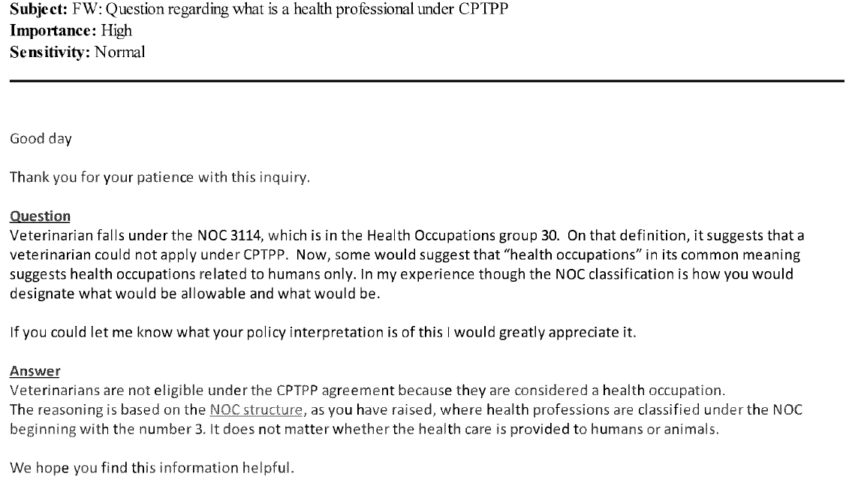
On December 30, 2018 the Comprehensive and Progressive Agreement for Trans-Pacific Partnership (the “CPTPP“) came into effect. The CPTPP will result in it being easier for citizens of countries that have ratified the CPTPP to work in Canada. As of writing, these countries include Australia, Japan, Mexico, New Zealand, Singapore and Vietnam. The benefits are not the same, however, for all countries. The categories are: Business Visitors; After – Sales Services; Investors; Intra-Corporate Transferees; and Professionals. Business Visitors The Business Visitors category applies to all countries that have ratified the CPTPP. As well, permanent residents of Australia and permanent residents of New Zealand may also qualify under this category. Activities that Business Visitors may perform include: Meetings and consultations Research and design Manufacturing and production Marketing Sales Distribution After-sales or after-lease services General services After-Sales Service The CPTPP’s After-Sales Service provisions apply to citizens of Australia, Mexico and New Zealand. Personnel who possess specialized knowledge essential to a seller’s or lessor’s contractual obligation (such as installers, repairers and maintenance personnel, and supervisors) may enter Canada for the purpose of performing services and training workers to perform services pursuant to a warranty (during the life of the warranty) or other service contract incidentals … Read More
Unclear Forms and Checklists
Given the frequency with which Immigration, Refugees and Citizenship Canada (“IRCC“) updates its checklists, forms and website it is not surprising that people often find some of IRCC’s content to be unclear. The Federal Court of Canada, citing rule of law principles, has stated that where IRCC content is objectively unclear that flexibility is required. In Lim v. Canada (Minister of Citizenship and Immigration), 2005 FC 657, Justice von Finkenstein stated that: The actions of CIC in this instance lack common sense. As Muldoon J. so aptly put it in Taei v. Canada (Minister of Employment and Immigration), [1993] F.C.J. No. 293 (dealing with a refugee claim rather than a live-in caregiver) “(t)he rule of law does not require that statutes be read and interpreted in a robotic mindless manner. Common sense has not been abolished either by the Charter or by statute”. It is also useful to recall the admonition of Jerome A.C.J. in Thakorlal Hajariwala v. M.E.I. [1989] 2 F.C. 79 that ” the purpose of the statute [then the Immigration Act which is now the Immigration and Refugee Protection Act] is to permit immigration, not to prevent it.” In Jalota v. Canada (Citizenship and Immigration), 2013 FC 1176, Justice Phelan criticized IRCC for refusing a restoration of student status … Read More
CBSA Work Permit Checklists in the Pacific Highway District
As of December 14, 2018 the Canada Border Services Agency (“CBSA”) has implemented a document checklist for work permit applications in the Pacific Highway District. It applies to Douglas, Pacific Highway, Boundary Bay, Aldergrove and Abbotsford-Huntingdon. The checklists, which do not yet appear on the CBSA website, are below.
Statistics – Temporary Residence Approvals by Visa Office
I was recently provided with Access to Information Act results that an immigration consultant obtained which lists for 2016, 2017 and Jan – Aug 2018 the number of applications finalized, the approval rate, and the processing time, for the following applications from every IRCC office: Temporary Resident Visa Study Permit Work Permit Electronic Travel Authorisation The results can be found in the embedded PDF below. Here is another PDF which shows the work permit approval rates by country. Here are the approval statistics based on province of destination. And finally, here are the work permit approval rates based on NOC. Finally, the approval rates for Hong Kong and China for temporary residence applications can be found here.
Seeing the Forest Through the Weeds – Canada’s Immigration System Works
In a previous Perspectives article I criticized the Liberal Government of Canada’s decision to establish a rigid intake procedure that returned applications in Canada’s family reunification programs for incompleteness. While doing so enabled the government to boast about overall processing times that were technically reduced, for many the consequences were actually lengthier separations and loss of status in Canada. At the same time, I recognized that it was understandable that the Liberals adopted this strict intake system. I wrote: Given that processing times are easily measured, it is understandable that the government wants to reduce them. Indeed, it is hard to go a few days without reading a media story about a family upset with how long their immigration application is taking. Perhaps in exchange for immigration stakeholders not complaining to the media every time processing times increase, Canada’s immigration department could stop applying such a strict approach to accepting an application into processing. It is of course understandable that applicants and their family members who are directly impacted by Canada’s immigration system would emotionally express frustration. It can also be a useful strategy to obtain results, as media pressure can sometimes persuade Canadian immigration officials to take certain actions. However, the level of condensation … Read More