


In this episode, we break down IRCC’s practice of rejecting applications for incompleteness, often for minor technical issues. Effectively a form of stats manipulation, this practice creates a misleading picture of departmental efficiency while leaving applicants stranded, often forcing them to restart the process for trivial errors.
Category Based Draws
The following is a memo to the minister on the introduction of category based draws. Here is another Memorandum to the Minister on adding Education specific draws. IRCC IMMReps E-mails
What Happens at CBSA – The Port of Entry
A main purpose of the Canada Border Services Agency (the “CBSA“) is to determine whether people are inadmissible to Canada and, if they are, next steps. Section 15(1) of Canada’s Immigration and Refugee Protection Act (the “IRPA“), read in conjunction with r. 28(b) of Canada’s Immigration and Refugee Protection Regulations (the “IRPA”) authorizes Border Services Officers (“BSOs“) to examine people who are entering Canada to determine their admissibility. As well, IRPA s. 18(1) provides that every person seeking to enter Canada must appear for an examination at CBSA to determine whether that person has a right to enter Canada or is or may become authorized to enter and remain in Canada. This post is a summary of the training manual from the CBSA’s Officer Induction Training Program. A full copy can be found at the bottom of the post. Examination Timeline Regulation 37 of the IRPR define when a CBSA examination at a port of entry (a “POE“) ends. It states that an examination ends once one of the following occurs: A final determination is made that the person has a right to enter Canada, or is authorized to enter Canada, and leaves the port of entry. It is important to note that an examination is not over simply … Read More
Borderlines Podcast #148 – The Vietnamese Boat People, with Misty Ty and Mymy Huynh
Misty Ty is a documentary film maker. Her father, Robert Ty, was the owner of a shipping company whose cargo ship, The Tung An, encountered a fishing vessel with over 200 people. Misty Ty was one of the children on that boat. The Vietnamese Boat People were refugees who fled Vietnam by sea after the fall of Saigon in 1975, escaping communist rule and persecution. Over one million people would flee. Several hundred thousand would perish due to storms, starvation, pirate attacks, and overcrowded boats. In response to the humanitarian crisis, Canada would introduce its private refugee sponsorship program, and resettle tens of thousands of Indochinese. Misty’s website for the project is thetungan.com. She would love to hear from anyone who was on, or whose relatives were on, the Tung An.
IRCC Questions and Answers
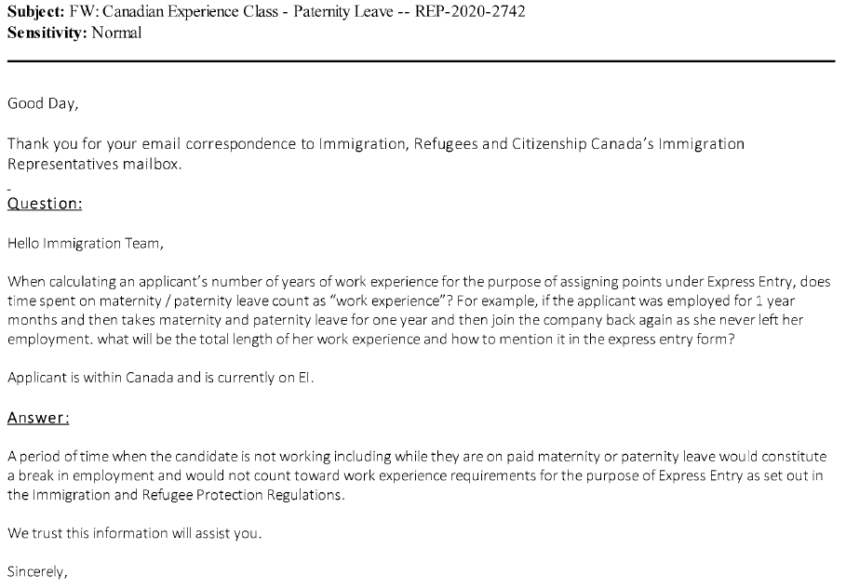
Immigration lawyers and consultants are able to e-mail Immigration, Refugees and Citizenship Canada (“IRCC“) to ask general questions about how programs work. In 2018 we submitted an Access to Information Act request for many of the questions that were submitted in the first half of 2018. I have uploaded the results of our request here. You can see a list of most of the questions that are answered below. A Canadian Bachelor degree was obtained in two years as the person has used some credits from a previous bachelor degree obtained in a foreign country. The curriculum grid for this Canadian Bachelor Degree is 11 quarters with a total of 180 credits. This same person has also a 1-year diploma from a private institution in Canada. Under the CRS points for Express Entry, could we consider that this person could claim points for having two or more degrees, diplomas or certificates only considering the Canadian credentials? As there is the information that one of the credentials must be at least 3 years, I was wondering if IRCC would consider the length of study or the length of the program if was not accredited due to credit transferring? What should we inform at the … Read More
Borderlines Podcast #147 – A Debate on Banning Immigration Consultants, with Former Visa Officer Martin Levine
Martin Levine was a Visa Officer and Analyst at Citizenship and Immigration Canada from 1978 – 2009. He then worked as a contract employee as an ATIP Analyst for numerous federal departments. He previously appeared on Episodes #108 and #110. Towards the end of episode #110 Martin commented that he thought the immigration consultant profession shouldn’t exist. Steven said that this was a huge topic and probably deserved its own episode. In this episode Martin explains why he believes that Canada should abolish the immigration consultant profession. Steven and Deanna disagree. Numerous arguments and counter arguments are discussed.
Borderlines Podcast #146 – Employment Law for Immigrants and Foreign Workers, with Erin Brandt
Erin Brandt is a co-founder of PortaLaw, a Vancouver law firm which specializes in employment law. Audience submitted questions that we discuss include: Is it illegal for employers to not provide reference letters necessary for immigration purposes or to charge their employees for them? Is it illegal for employers with foreign worker employees to not apply for LMIAs to try to extend their employees’ employment? Can employers distinguish between Canadian citizens, permanent residents and foreign workers when hiring? Can an employer not hire a foreign national or asylum claimant if they are likely to be deported? Is it ok for an employer to ask if someone is an asylum claimant? If an employer learns that an employee is without status – and the employee lied to them – can they legitimately refuse to pay the employee out for work completed during this time? If in order to meet prevailing wage an employer increases the wages of all of their LMIA-based TFWs, is it discrimination to not also increase it for their permanent resident or Canadian employees? We also discuss the Ontario Court of Appeal decision in Imperial Oil Limited v. Haseeb, 2023 ONCA 364, upheld a Human Rights … Read More
Punjabi Weddings
The following is an IRCC one-pager on the major ceremonies of a Punjabi wedding.
Borderlines Podcast #145 – Minister Miller Blackmails the Provinces on Immigration Levels, plus IRCC Refusals of Provincial Nominees
This episode answers a listener topic request about an increase in IRCC refusals of provincial nominees. As well, Steven offers his unimpressed thoughts on Marc Miller’s recent statement in response to complaints about huge decreases in provincial nominee quotas that “Provinces and Territories that are willing to work in a responsible manner with Canada, including playing a role in taking on asylum seekers, will have an opportunity to regain coveted Provincial Nominee spots.”
Borderlines Podcast #144 – Restricting Open Spousal Work Permits
<iframe src=”https://embed.acast.com/659f464c3f69070017409684/67991fb2a234f420da42816b?theme=light” frameBorder=”0″ width=”100%” height=”110px”></iframe> On January 21, 2025, IRCC restricted the availability of open spousal work permits to principal applicants working in certain “skilled” professions. Family open work permits are now limited to spouses of foreign workers who are employed in TEER 0 or 1 occupations, or select TEER 2 or 3 occupations in sectors with labour shortages or linked to government priorities such as natural and applied sciences, construction, health care, natural resources, education, sports and military sectors. The move more than reversed a December 2, 2022, announcement that IRCC would be allowing most spouses of workers in Canada to obtain open work permits because, according to the government, it would “improve the emotional well-being, physical health and financial stability of workers by keeping families together” and that the “worker will better integrate into their overall work environment and community.”