


Administrative deferrals of removal (“ADR“) are temporary measures when the Government of Canada determines that immediate action is needed to temporarily defer removals of foreign nationals to countries experiencing humanitarian crisis. Once the situation in a country stabilizes the ADR is lifted and removals resume. Those who are inadmissible to Canada on grounds of criminality, international or human rights violations, organized crime, or security can still be removed despite the ADR. H&C Applications Pursuant to the Federal Court of Canada decision in Bawazir v. Canada (Citizenship and Immigration), 2019 FC 623 (“Bawazir“), the existence of an ADR should not negate the hardship analysis that officers conduct in humanitarian & compassionate applications. As Justice Norris noted: One can certainly understand why Mr. Bawazir would like to secure his status in Canada by obtaining permanent residence here. In my view, a reasonable and fair-minded person would judge the requirement that he leave Canada and go to a war zone where a dire humanitarian crisis prevails so that he could apply for permanent residence as a misfortune potentially deserving of amelioration. The existence of the ADR demonstrates that Canada views the conditions in Yemen as a result of the civil war to “pose … Read More
Express Entry Imm Rep Q&A
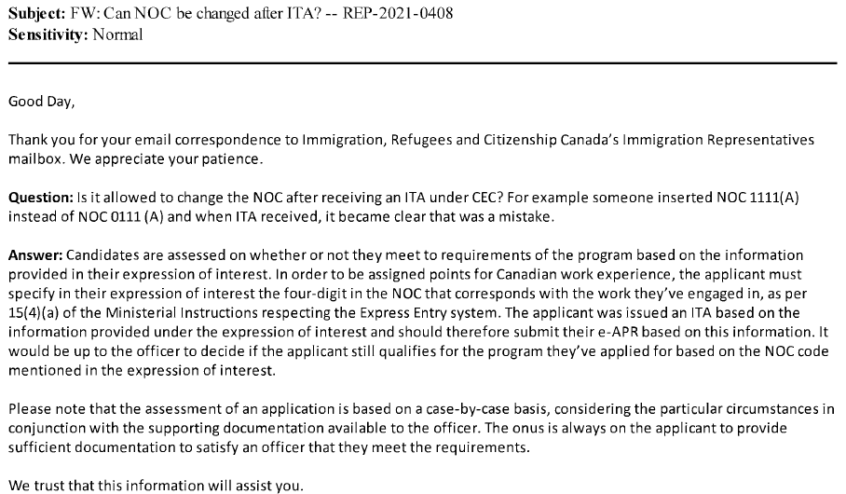
The following PDFs contain several Express Entry Q&As that were obtained through an Access to Information Act request. The topics include what documentation is required in an Express Entry application, enclosing rehabilitation applications with Express Entry, what counts as a ‘certificate of qualification’, points for skills transferability, and qualifying arranged employment. Here is more functional guidance about concurrent work experience.
Spousal Sponsorship Bar on Violent Spouses
In April the Gazette announced that a sponsorship bar would soon come into effect prohibiting individuals that have been convicted of certain offenses from sponsoring family members. One of the offenses that would result in a bar was violence against someone that the wannabe sponsor had dated, which seemed a little vague. Now that the sponsorship bar has come into effect, and Citizenship and Immigration Canada has released a detailed Operational Bulletin on the matter, lets see if the if the new rule is a little clearer. The Operational Bulletin starts by noting the gap in the law exposed by the Brar (2008 FC 1285) decision, where the Federal Court found that an individual who had murdered his brother’s wife was allowed to sponsor his own wife, as the Immigration and Refugee Protection Regulations did not specifically bar an individual who had killed a sister-in-law from sponsoring another family member. Under the new Regulations, subject to certain exceptions, anyone convicted of an indictable offense involving the use of violence punishable by a maximum term of imprisonment of at least 10 years or an attempt to commit such an offense will be barred from sponsorship. As well, subject to certain exceptions, … Read More
Leaving Canada by the end of Authorized Stay
How can temporary foreign workers show that they will leave Canada at the end of their work permit?
Non-Accompanying Family Members and Express Entry
Express Entry applicants often find it confusing to understand how declaring a family member as “non-accompanying” affects their Comprehensive Ranking System (CRS) score. It is important to know how Immigration, Refugees and Citizenship Canada (IRCC) treats non-accompanying spouses, partners, and children when calculating Express Entry points. Under Express Entry, family members include a spouse or common-law partner, dependent children, and dependent children of dependent children. Whether or not these family members will be coming to Canada with the applicant, they must be declared in the application. This is because IRCC requires all family members to be declared and examined for medical and security admissibility, even if they are not accompanying the applicant to Canada. When it comes to the CRS score, declaring a spouse or partner as “non-accompanying” has a clear impact. If an applicant has a spouse or common-law partner but declares them as non-accompanying, the applicant is assessed under the points grid used for single applicants rather than the one used for applicants with a spouse or partner. The single applicant grid generally results in a higher CRS score because it allows the applicant to receive additional points for factors such as age, education, language proficiency, and Canadian … Read More
The Right of Permanent Resident Visa Holders to Appeal to the IAD
Section 63(2) of the Immigration and Refugee Protection Act (“IRPA“) provides that: A foreign national who holds a permanent resident visa may appeal to the Immigration Appeal Division against a decision to make a removal order against them made under subsection 44(2) or made at an admissibility hearing. The jurisprudence around this section has seemingly been to narrow it. Jurisprudence Ismail v. Canada On June 5, 2015, the appellants in Elham Fathy Elsayed Ismail et al v. Minister of Citizenship and Immigration, A-203-15, discontinued their appeal of the Federal Court’s decision in Ismail v. Canada (Citizenship and Immigration), 2015 FC 338 (“Ismail“). That question was: For the purposes of determining its jurisdiction to hear an appeal pursuant to subsection 63(2) of the IRPA, shall the validity of the permanent resident visa be assessed by the IAD at the time of arrival in Canada or at the time the exclusion order is made? The question is important because it addresses a growing tendency of the Canada Border Services Agency (“CBSA“) to defer the examination of foreign nationals possessing permanent resident visas seeking to become permanent residents where CBSA suspects that the foreign nationals may not be admissible to Canada, rather than preparing an inadmissibility report. During … Read More
Canadian Refugee Claims from Kenya
The following is a sample successful Canadian refugee claim from Kenya. I have re-posted it on order to show the different factors that applicants must demonstrate in their asylum claim.
Working without a work permit: what jobs can a visitor do in Canada?
The following is an article that I recent wrote for The Canadian Immigrant: It is generally understood that visitors to Canada cannot work without work permits. The consequences for doing so can include removal from Canada, being unable to apply for work permits for six months, year-long prohibitions on returning to Canada and even possible criminal sanctions for employers. Canadian immigration legislation defines “work” broadly. It includes any activities for which wages are paid or commission is earned, and any activity that competes directly with the activities of Canadian citizens or permanent residents in the Canadian labour market. Because of this, volunteer work, unpaid internships and practicums may also require work permits. However, while the definition of what constitutes work is broad, there are many activities that people would generally consider work that do not require work permits. Remote work In our increasingly globalized and digitized world, perhaps the most important work permit exemption is for remote work. Canada’s immigration department allows visitors to Canada to perform long-distance (by telephone or internet) work if their employer is outside Canada and they are remunerated from outside Canada. As such, many people who work remotely for companies abroad are able to reside … Read More
Inadmissible for Crimes Against Humanity

Section 35 of the Immigration and Refugee Protection Act (the “IRPA“) provides that: Human or international rights violations 35 (1) A permanent resident or a foreign national is inadmissible on grounds of violating human or international rights for (a) committing an act outside Canada that constitutes an offence referred to in sections 4 to 7 of the Crimes Against Humanity and War Crimes Act; (b) being a prescribed senior official in the service of a government that, in the opinion of the Minister, engages or has engaged in terrorism, systematic or gross human rights violations, or genocide, a war crime or a crime against humanity within the meaning of subsections 6(3) to (5) of the Crimes Against Humanity and War Crimes Act; or (c) being a person, other than a permanent resident, whose entry into or stay in Canada is restricted pursuant to a decision, resolution or measure of an international organization of states or association of states, of which Canada is a member, that imposes sanctions on a country against which Canada has imposed or has agreed to impose sanctions in concert with that organization or association. Internal Guideline Immigration, Refugees and Citizenship Canada (“IRCC“) has produced a useful internal document … Read More
The Parent & Grandparent Sponsorship Program

Under the Parent & Grandparent Sponsorship Program (the “PGP“), Canadian citizens and permanent residents can sponsor their foreign national parents and grandparents. Sponsors must sign an undertaking with the Minister of Citizenship and Immigration (“IRCC“) or with the Ministère de l’Immigration, de la Diversité et de l’Inclusion for those in Quebec. The undertaking ensures that the sponsored individuals and their family members do not have to apply for social assistance. The length of undertaking in the PGP is 20 years. As per the IRCC website, sponsors must: be 18 years of age or older; be a Canadian citizen, Registered Indian or permanent resident; be sponsoring their parents or grandparents; live in Canada; sign an undertaking promising to provide for the basic requirements of the person being sponsored; sign an agreement with the person theyare sponsoring; and prove that they have sufficient income. Co-signers are permissible. Exclusions A Canadian citizen or permanent resident cannot be a sponsor if they: are in receipt of social assistance for a reason other than disability; are in default of an undertaking, an immigration loan, a performance bond, or family support payments; are an undischarged bankrupt; were convicted of an offence of a sexual nature, a violent criminal offence, an … Read More