


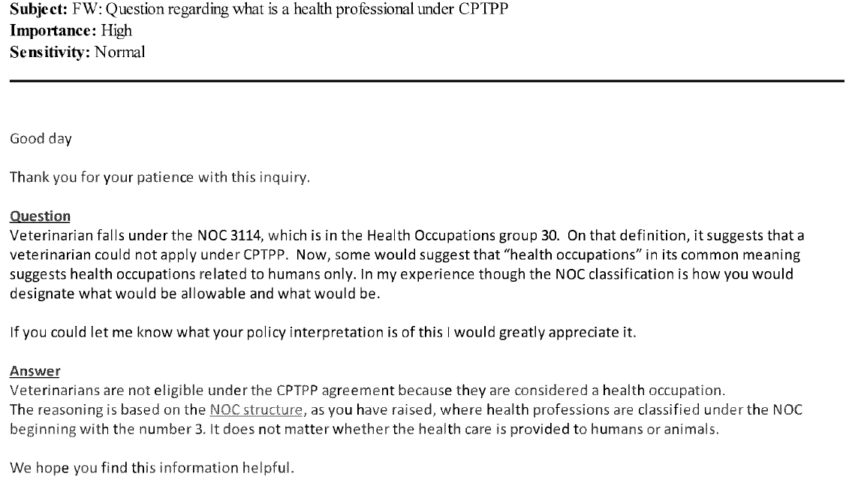
On December 30, 2018 the Comprehensive and Progressive Agreement for Trans-Pacific Partnership (the “CPTPP“) came into effect. The CPTPP will result in it being easier for citizens of countries that have ratified the CPTPP to work in Canada. As of writing, these countries include Australia, Japan, Mexico, New Zealand, Singapore and Vietnam. The benefits are not the same, however, for all countries. The categories are: Business Visitors; After – Sales Services; Investors; Intra-Corporate Transferees; and Professionals. Business Visitors The Business Visitors category applies to all countries that have ratified the CPTPP. As well, permanent residents of Australia and permanent residents of New Zealand may also qualify under this category. Activities that Business Visitors may perform include: Meetings and consultations Research and design Manufacturing and production Marketing Sales Distribution After-sales or after-lease services General services After-Sales Service The CPTPP’s After-Sales Service provisions apply to citizens of Australia, Mexico and New Zealand. Personnel who possess specialized knowledge essential to a seller’s or lessor’s contractual obligation (such as installers, repairers and maintenance personnel, and supervisors) may enter Canada for the purpose of performing services and training workers to perform services pursuant to a warranty (during the life of the warranty) or other service contract incidentals … Read More
Unclear Forms and Checklists
Given the frequency with which Immigration, Refugees and Citizenship Canada (“IRCC“) updates its checklists, forms and website it is not surprising that people often find some of IRCC’s content to be unclear. The Federal Court of Canada, citing rule of law principles, has stated that where IRCC content is objectively unclear that flexibility is required. In Lim v. Canada (Minister of Citizenship and Immigration), 2005 FC 657, Justice von Finkenstein stated that: The actions of CIC in this instance lack common sense. As Muldoon J. so aptly put it in Taei v. Canada (Minister of Employment and Immigration), [1993] F.C.J. No. 293 (dealing with a refugee claim rather than a live-in caregiver) “(t)he rule of law does not require that statutes be read and interpreted in a robotic mindless manner. Common sense has not been abolished either by the Charter or by statute”. It is also useful to recall the admonition of Jerome A.C.J. in Thakorlal Hajariwala v. M.E.I. [1989] 2 F.C. 79 that ” the purpose of the statute [then the Immigration Act which is now the Immigration and Refugee Protection Act] is to permit immigration, not to prevent it.” In Jalota v. Canada (Citizenship and Immigration), 2013 FC 1176, Justice Phelan criticized IRCC for refusing a restoration of student status … Read More
CBSA Work Permit Checklists in the Pacific Highway District
As of December 14, 2018 the Canada Border Services Agency (“CBSA”) has implemented a document checklist for work permit applications in the Pacific Highway District. It applies to Douglas, Pacific Highway, Boundary Bay, Aldergrove and Abbotsford-Huntingdon. The checklists, which do not yet appear on the CBSA website, are below.
Statistics – Temporary Residence Approvals by Visa Office
I was recently provided with Access to Information Act results that an immigration consultant obtained which lists for 2016, 2017 and Jan – Aug 2018 the number of applications finalized, the approval rate, and the processing time, for the following applications from every IRCC office: Temporary Resident Visa Study Permit Work Permit Electronic Travel Authorisation The results can be found in the embedded PDF below. Here is another PDF which shows the work permit approval rates by country. Here are the approval statistics based on province of destination. And finally, here are the work permit approval rates based on NOC. Finally, the approval rates for Hong Kong and China for temporary residence applications can be found here.
Seeing the Forest Through the Weeds – Canada’s Immigration System Works
In a previous Perspectives article I criticized the Liberal Government of Canada’s decision to establish a rigid intake procedure that returned applications in Canada’s family reunification programs for incompleteness. While doing so enabled the government to boast about overall processing times that were technically reduced, for many the consequences were actually lengthier separations and loss of status in Canada. At the same time, I recognized that it was understandable that the Liberals adopted this strict intake system. I wrote: Given that processing times are easily measured, it is understandable that the government wants to reduce them. Indeed, it is hard to go a few days without reading a media story about a family upset with how long their immigration application is taking. Perhaps in exchange for immigration stakeholders not complaining to the media every time processing times increase, Canada’s immigration department could stop applying such a strict approach to accepting an application into processing. It is of course understandable that applicants and their family members who are directly impacted by Canada’s immigration system would emotionally express frustration. It can also be a useful strategy to obtain results, as media pressure can sometimes persuade Canadian immigration officials to take certain actions. However, the level of condensation … Read More
Work Permits for Circus Workers
Canadian immigration law provides circuses with several ways to access foreign talent. First, many circus employees will qualify for work permit exemptions under r. 186(g) of the Immigration and Refugee Protection Regulations. As the Immigration, Refugees and Citizenship Canada website states: Foreign, travelling circus performers should, in most cases, meet the requirements of paragraph R186(g), as they are usually coming for a time-limited engagement and are not in an employment relationship with a Canadian organization. The IRCC website goes on to state the following for Canadian circuses: In cases where the employer is Canadian, there is entry into the Canadian labour market, so [a Labour Market Impact Assessment] is usually required. Some exceptions may apply to Canadian-based circuses, such as Cirque du Soleil, that can demonstrate the significant social, cultural or economic benefit they provide to Canada. In these cases, foreign circus performers, choreographers, artistic directors and others (that is, staff who are essential to the creative and artistic processes) who are working for a Canadian-based circus may be authorized to enter Canada, under the significant benefit exemption. Circuses wishing to benefit from this exemption should be able to demonstrate that their shows are international in nature (for example, in presentation or because … Read More
Borderlines Podcast #26 – Representing Edward Snowden and an Overview of Hong Kong Refugee Law, with Robert Tibbo
Robert Tibbo is a Canadian lawyer based in Hong Kong, where he has an active human rights and refugee law practice. He has served as counsel in many notable cases, including Edward Snowden, a former contractor for the United States government who copied and leaked classified information from the National Security Agency in 2013. Peter and Robert discuss what it is like to practice refugee law in Hong Kong and about Robert’s representation of Edward Snowden, which at one point included arranging for Mr. Snowden to stay with other asylum claimants in Hong Kong to avoid being detected by the authorities. https://embed.acast.com/659f464c3f69070017409684/659f46527d81c00017cf4f3b?theme=light&cover=false 2:00 – What was Robert’s career path that led him to become a human rights lawyer in Hong Kong? 7:12 – What are the primary source countries of people who are coming into Hong Kong to make refugee claims? 9:00 – What is the asylum claim process like in Hong Kong? 17:20 – What does everyday life look like for an asylum claimant in Hong Kong? 26:30 – How did Mr. Tibbo come to represent Edward Snowden? 34:00 – What was Mr. Tibbo’s legal strategy for Edward Snowden? 38:00 – What was the legal context in which Mr. … Read More
The Conservative Case for Confidence in Canada’s Immigration System
From 2008 – 2013, Jason Kenney, currently the Leader of Alberta’s United Conservative Party, then a Member of Parliament with the Conservative Party of Canada, served as Canada’s Minister of Citizenship and Immigration. During his time as the head of Canada’s immigration department, Minister Kenney implemented many comprehensive reforms to Canadian immigration law, most of which remain in place today. He also reached out to visible minority communities across Canada, and in an interview with the Globe and Mail noted that immigrants often reflect conservative ideals, stating that “you observe how these new Canadians live their lives. They are the personification of Margaret Thatcher’s aspirational class. They’re all about a massive work ethic.” Unfortunately, the political parties which bear the conservative banner have either abandoned, or seem close to abandoning, this embrace of immigration. From a political standpoint, it is not difficult to see why this is occurring. At the federal level, supporters of the Conservative Party of Canada appear to have a greater discomfort with visible minorities than supporters of other political parties. According to a 2017 EKOS survey, in response to the question “forgetting about the overall number of immigrants coming to Canada, of those who come would … Read More
The Defense of Necessity and Inadmissibility
In addition to the defence of duress, discussed elsewhere on this blog here, the Federal Court of Canada in Canada (Public Safety and Emergency Preparedness) v. Aly has determined that the defence of duress can apply to negate an inadmissibility finding for criminality. The defence of necessity requires proof that: there exists a clear and imminent peril; there is no reasonable legal alternative available to disobeying the law; and there is proportionality between the harm inflicted and the harm avoided. As the Supreme Court of Canada noted in R v. Latimer, the requirement for “clear and imminent peril” means that: [D]isaster must be imminent, or harm unavoidable and near. It is not enough that the peril is foreseeable or likely; it must be on the verge of transpiring and virtually certain to occur. In Perka, Dickson J. expressed the requirement of imminent peril at p. 251: “At a minimum the situation must be so emergent and the peril must be so pressing that normal human instincts cry out for action and make a counsel of patience unreasonable”. The Perka case, at p. 251, also offers the rationale for this requirement of immediate peril: “The requirement . . . tests whether it … Read More
Borderlines Podcast #25 – Protecting Foreign Workers and Employer Compliance Inspections, with Meera Thakrar
The Government of Canada, as well as several provincial governments, have introduced several measures to protect temporary foreign workers and maintain the integrity of Canada’s foreign worker programs. Meera Thakrar is a Canadian immigration lawyer whose practices focus on helping companies recruit and retain foreign workers. Meera joins Peter Edelmann, Deanna Okun-Nachoff and Steven Meurrens to discuss various measures that different levels of government have introduced to protect foreign workers, challenges do governments face in this task and how employer compliance inspections work. 2:15 – Deanna discusses vulnerabilities that caregivers face. These include nonpayment of wages, excessive hours and more. What aggravates the situation is that because caregivers typically seek permanent residency and reporting abuse could potentially jeapordize this. 4:30 – What are some of the motivations of caregiver employers who exploit their foreign workers? What are some possible solutions to reduce the vulnerability of caregivers? 10:20 – Do what extent does the caregiver program deflate Canadian wages? To what extent does the fact that foreign workers provide cheap labour, making goods and services affordable, create a disincentive to stricter enforcement of foreign worker rights. 12:20 – An overview of how the government’s enforcement of compliance in the Temporary Foreign … Read More