


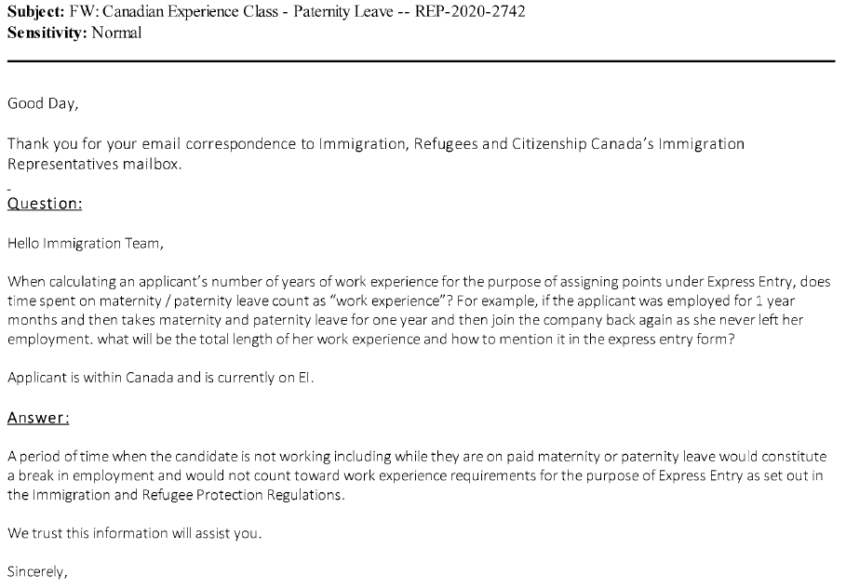
Immigration lawyers and consultants are able to e-mail Immigration, Refugees and Citizenship Canada (“IRCC“) to ask general questions about how programs work. In 2018 we submitted an Access to Information Act request for many of the questions that were submitted in the first half of 2018. I have uploaded the results of our request here. You can see a list of most of the questions that are answered below. A Canadian Bachelor degree was obtained in two years as the person has used some credits from a previous bachelor degree obtained in a foreign country. The curriculum grid for this Canadian Bachelor Degree is 11 quarters with a total of 180 credits. This same person has also a 1-year diploma from a private institution in Canada. Under the CRS points for Express Entry, could we consider that this person could claim points for having two or more degrees, diplomas or certificates only considering the Canadian credentials? As there is the information that one of the credentials must be at least 3 years, I was wondering if IRCC would consider the length of study or the length of the program if was not accredited due to credit transferring? What should we inform at the … Read More
Ministerial Relief Exemption Requests
Foreign nationals who are found to be inadmissible to Canada on the basis of security (including espionage, subversion, engaging in terrorism, or being a member of a group that engages in terrorism), certain human and international rights violations, or organised crime can still visit or immigrate to Canada despite being inadmissible for such serious reasons if they satisfy the Minister of Public Safety and Emergency Preparedness (the “Minister“) that their entry to Canada is not contrary to Canada’s national interest. Such applications are referred to as “Ministerial Relief applications.” In assessing a Ministerial Relief application, Canadian immigration law somewhat confusingly provides that the Minister “may only take into account national security and public safety considerations, but, in his or her analysis, is not limited to considering the danger that the foreign national presents to the public or the security of Canada.” In Thomas v. Canada (Citizenship and Immigration), 2022 FC 1169, Madam Justice Heneghan affirmed that tthe Minister is required to consider whether someone is a danger to Canada. Ministerial Relief applications, previously done under ss. 34(2), 35(2), and 37(2)(a) of Canada’s Immigration and Refugee Protection Act, and now s. 42.1, have long been problematic. As the Government of Canada noted when it … Read More
Self-Employed Class – What is Self Employment
To qualify for the Self-Employed Class in Canada, applicants must demonstrate at least two years of relevant experience in cultural activities, athletics, or farm management (for applications submitted before March 10, 2018). This experience must fall within the five-year period prior to the application date and extend until a final decision is made on the application for permanent residency. Eligible experience includes either two one-year periods of self-employment in cultural activities, two one-year periods of participation at a world-class level in cultural activities, or a combination of both. Similarly, for athletics, the required experience can be met by either two one-year periods of self-employment in athletics, two one-year periods of participation at a world-class level in athletics, or a combination of both. What is Self-Employment? The Self-Employed Class section of the Immigration, Refugees and Citizenship Canada (“IRCC“) website does not describe what self-employment is. However, the Canadian Experience Class section of the website provides the following: Determining an applicant’s employment status Applicants under the CEC must satisfy a CIC officer that they meet all program requirements [R87.1]. Any period of self-employment shall not be included in calculating the period of qualifying work experience under the CEC [R87.1(3)(b)]. As such, the … Read More
Court Certifies Question on Judicial Review of 117(9)(d) Refusals
The Federal Court (the “Court“) in Habtenkiel v. Canada (Citizenship and Immigration), has certified a question that if answered in the affirmative would seem to pretty much shut the door on humanitarian & compassionate (“H&C“) appeals of s. 117(9)(d) refusals. The certified question is: In light of sections 72(2)(a), 63(1) and 65 of the Immigration and Refugee Protection Act, S.C. 2001, c. 27, and the case of Somodi v. Canada (Minister of Citizenship and Immigration), 2009 FCA 288 (CanLII), [2010] 4 F.C.R. 26 (F.C.A.), where the applicant has made a family class sponsorship application and requested humanitarian and compassionate considerations within the application, is the applicant precluded from seeking judicial review by the Federal Court before exhausting their right of appeal to the Immigration Appeal Division where the right of appeal is limited pursuant to paragraph 117(9)(d) of the Immigration and Refugee Protection Regulations, SOR/2002-227? That question is long and confusing, but lets break it down.
C-11 Work Permits
Immigration, Refugees and Citizenship Canada’s (“IRCC”) International Mobility Program contains Labour Market Impact Assessment (“LMIA”) exemption code C-11, titled Canadian interests – Significant benefit – Entrepreneurs/self-employed candidates seeking to operate a business. The exemption falls under Regulation 205(a) of the Immigration and Refugee Protection Regulations. According to the IRCC website, the eligibility requirement can be divided into those who seek permanent residence and those who don’t. For those who seek permanent residence, an applicant must: be an actual or potential provincial nominee undertaking business activities or be a Quebec-destined entrepreneur or self-employed person issued a Quebec Selection Certificate (a “CSQ”); and have a letter of support from the province or territory (this letter of support should count towards evidence that their admission to Canada to operate a business may create significant economic, social or cultural benefit to Canada) or a request from the Ministère de l’Immigration, de la Diversité et de l’Inclusion (MIDI) requesting early entry. For those who do not seek permanent residence, an applicant must: demonstrate that their admission to Canada to operate their business would generate significant economic, social or cultural benefits or opportunities for Canadian citizens or permanent residents. Benefits to Canadian clients of a self-employed worker may … Read More
What Happens After a Judicial Review
The Federal Court of Canada (the “Federal Court“) has the jurisdiction to review immigration decisions, including those of Immigration, Refugees and Citizenship Canada (“IRCC“) and the Canada Border Services Agency (“CBSA“). The Federal Court will not order a specific result. Rather, the Federal Court will order that the application be sent back for re-determination by a different officer. Many people often wonder how that process works. Jurisprudence In Canada (Commissioner of Competition) v. Superior Propane Inc. (C.A.), 2003 FCA 53, the Federal Court of Appeal stated: The principle of stare decisis is, of course, well known to lawyers and judges. Lower courts must follow the law as interpreted by a higher co-ordinate court. They cannot refuse to follow it: Canada Temperance Act (The), Re, 1939 CanLII 58 (ON CA), [1939] O.R. 570 (C.A.), at page 581, affd 1946 CanLII 351 (UK JCPC), [1946] 2 D.L.R. 1 (P.C.); Woods v. The King, 1951 CanLII 36 (SCC), [1951] S.C.R. 504, at page 515. This principle applies equally to tribunals having to follow the directions of a higher court as in this case. On redetermination, the duty of a tribunal is to follow the directions of the reviewing court. In Canada (Citizenship and … Read More
Visiting Canada? How to fill out a successful temporary visa application
In recent years, more than one million people annually have been applying for visitor visas to visit Canada. Several hundred thousand more apply for work permits or study permits each year. Immigration, Refugees and Citizenship Canada will refuse around 20 per cent of these applications, sending a generic refusal letter, providing vague reasons off a checklist. What most refused applicants don’t realize is that behind these decisions are additional, often very detailed reasons that aren’t provided in the refusal letter. These internal reasons can range from a few short sentences, to sometimes even more than a page of reasoning that IRCC does not share with the applicant. It is important for refused applicants to apply for and obtain the full internal reasons for IRCC’s refusal of their application before they try to reapply. (Learn how at canadianimmigrant.ca/immigrate “Application refused? What CIC states in refusal letters is not the whole story.”) It is also important to understand the numerous factors that visa officers consider when assessing temporary residency applications to determine whether someone will leave Canada by the end of their authorized stay. By knowing what these factors are, applicants can maximize the likelihood of successfully assembling a strong visa application. … Read More
Open Spousal Work Permits

In a previous blog post I wrote about how Immigration, Refugees and Citizenship Canada (“IRCC”) was increasingly focusing on genuineness in open spousal work permits. On September 27, 2021 IRCC updated its webpage to reform the open spousal work permit program.
Study Permit Financial Sufficiency
The Immigration, Refugees and Citizenship Canada Guidelines state: Students are required to demonstrate financial sufficiency for only the first year of studies, regardless of the duration of the course or program of studies in which they are enrolled. In other words, a single student entering a four-year degree program with an annual tuition fee of $15,000 must demonstrate funds of $15,000 to satisfy the requirements, and not the full $60,000 which would be required for four years. Officers should be satisfied however that the probability of funding for future years does exist (i.e., parents are employed); scholarship is for more than one year. Applications for extensions made to CPC-E must also meet this requirement. In assessing the adequacy of a student’s financial resources, officers may exercise discretion in the documentation they request from applicants. In situations where student applicants generally pose a very low risk regarding funds, officers may choose to limit or waive routine requirements for documentary evidence. Low-risk applicants are more likely to be exempted from the requirement to obtain a temporary resident visa. Based on the known incidence of indigent and non-bona fide applicants, reliability of financial documentation, and so forth, individual visa offices are best placed … Read More
Buying a Business that Has Foreign Workers
As an increasing number of Canadian employers employ foreign workers, and the Government of Canada is taking an increasingly strict approach in enforcing the rules regulating the employment of foreign workers, the issue of how companies can protect themselves when they buy companies that employ foreign workers is becoming increasingly significant. As well, as explained in detail on the Immigration, Refugees and Citizenship Canada (“IRCC”) website, corporate restructurings, mergers and acquisitions may themselves trigger work permit-related issues for employer compliance. It is accordingly important for all companies that are considering merging with or acquiring another company to consider whether (a) the transaction will result in the need for new work permits for existing employees and (b) whether the company that will be employing these foreign workers will become liable for any non-compliance of the previous entity. Understanding the “Successor in Interest” Concept While the IRCC website is clear that employers become responsible for compliance post restructuring, merger or acquisition, the issue of whether the new employers become liable for previous non-compliance is more nuanced, and depends on whether the new employer has become the “successor in interest” for the portion of the organization where the temporary foreign workers were employed. … Read More