


(the following is largely paraphrased from the IRCC website) The North American Free Trade Agreement (“NAFTA“) is a free trade agreement between Canada, the United States and Mexico. It facilities the temporary entry of individuals, including providing certain Americans and Mexicans with the ability to work in Canada without first requiring Labour Market Impact Assessments (“LMIAs“). NAFTA does not assist permanent admission, does not apply to permanent residents of the United States and Mexico and does not remove the need for Americans and Mexicans to undergo security screening before entering Canada. The categories are: Business Visitors; After – Sales Services; Investors; Intra-Corporate Transferees; and Professionals. Business Visitors To qualify as a business visitor, an American or Mexican citizen must be entering Canada to conduct activities that are international in scope, have no intention to enter the Canadian labour market, have their primary source of remuneration be outside of Canada and their principal place of business remain outside of Canada. For example, business visitors engage in international business activities related to research and design; growth, manufacture and production; marketing; sales; distribution; after-sales service; and general service. Typical examples of business activities include, but are not limited to, consultation, negotiation, discussion, research, … Read More
Inadmissibility for Subversion
Section 34 of the Immigration and Refugee Protection Act states: 34 (1) A permanent resident or a foreign national is inadmissible on security grounds for (a) engaging in an act of espionage that is against Canada or that is contrary to Canada’s interests; (b) engaging in or instigating the subversion by force of any government; (b.1) engaging in an act of subversion against a democratic government, institution or process as they are understood in Canada; (c) engaging in terrorism; (d) being a danger to the security of Canada; (e) engaging in acts of violence that would or might endanger the lives or safety of persons in Canada; or (f) being a member of an organization that there are reasonable grounds to believe engages, has engaged or will engage in acts referred to in paragraph (a), (b), (b.1) or (c). The Test for Subversion Canadian immigration legislation does not define subversion. Several Federal Court of Canada decisions have found that it does not require violence, including Oremade v Canada (Minister of Citizenship and Immigration), 2005 FC 1077, where Justice Phelan stated: I agree with the IAD’s conclusion that the term “by force” is not simply the equivalent of “by violence”. “By force” includes coercion or compulsion by violent means, coercion or compulsion … Read More
Dual Intent
One of the most common questions that immigration lawyers and consultants get asked is whether someone can visit, work or study in Canada if they either have a permanent residence application in process or plan to submit one. The issue is often especially pronounced in Canada’s family reunification programs, as families do not want to wait the years that it can take Immigration, Refugees and Citizenship Canada (“IRCC” ) to reunite, at least temporarily. It can also, however, arise in economic immigration programs, as foreign workers who arrive in Canada may ultimately want to immigrate. The same is true with students. Section 22(2) of Canada’s Immigration and Refugee Protection Act (the “IRPA“) states that: An intention by a foreign national to become a permanent resident does not preclude them from becoming a temporary resident if the officer is satisfied that they will leave Canada by the end of the period authorized for their stay. This is commonly referred to as the dual intent provision. Because of this, IRCC’s program manuals specifically state that “having 2 intents (one for temporary residence and 1 for permanent residence) is legitimate.” However, “the possibility that an applicant for temporary residence may, at some point in … Read More
Language Requirements and Work Permits
Regulation 200(3)(a) of the Immigration and Refugee Protection Regulations, SOR/2002-227 provides that an officer shall not issue a work permit to a foreign national if there are reasonable grounds to believe that the foreign national is unable to perform the work sought. An issue that is becomming increasingly common is whether someone has sufficient language ability to perform the work sought. IELTS For the most part, the Federal Court has been very deferential to visa officers when assessing whether they have the language requirements to perform the work sought. In Sen v. Canada (Citizenship and Immigration), 2022 FC 777, for example, Madam Justice Strickland determined that it was reasonable for a visa officer to determine that someone with a 3.5 IELTS reading score could not perform the duties of a Cook in Canada because they might be unable to follow recipes, read notes from serving staff, and read food safety instructions. In Singh v. Canada (Citizenship and Immigration), 2023 FC 170 , Madam Justice McDonald ruled that it was reasonable for a visa officer to determine that an individual with IELTS 5.0 in reading would be unable to safely read road signs, understand safety procedures and regulations, record cargo information and administer bills. … Read More
Borderlines Podcast #172 – Fast vs. Slow: Immigration’s Impact on Canada’s Economy & Regions, with Daniel Hiebert
In this episode, we dive into Dan Hiebert’s latest C.D. Howe Institute report on how different immigration rates shape Canada’s economic challenges and regional disparities. Key topics include: Aging Population and Immigration: Why Canada’s current immigration levels are insufficient to offset an aging population, and the implications of a simultaneously older and larger population. Regional Disparities: How immigration disproportionately fuels growth in major cities like Toronto and Vancouver, exacerbating regional population and economic gaps. Ethical and Practical Questions: Is it ethical to direct immigrants to settle in rural areas with limited services and opportunities? Should newcomers be expected to revitalize communities that Canadians are leaving? Policy Trade-offs: The tension between regionalization efforts, productivity goals, and francophone immigration targets. Dr. Hiebert also touches on innovative approaches, such as Sweden’s model of using social housing to encourage regional settlement, and previews his upcoming research on the role of ethnic enclaves in Canada. 🔗 Link to Paper: https://cdhowe.org/publication/fast-vs-slow-how-different-immigration-rates-can-impact-canadas-economic-challenges-and-regional-disparities/
Administrative Deferrals of Removal
Administrative deferrals of removal (“ADR“) are temporary measures when the Government of Canada determines that immediate action is needed to temporarily defer removals of foreign nationals to countries experiencing humanitarian crisis. Once the situation in a country stabilizes the ADR is lifted and removals resume. Those who are inadmissible to Canada on grounds of criminality, international or human rights violations, organized crime, or security can still be removed despite the ADR. H&C Applications Pursuant to the Federal Court of Canada decision in Bawazir v. Canada (Citizenship and Immigration), 2019 FC 623 (“Bawazir“), the existence of an ADR should not negate the hardship analysis that officers conduct in humanitarian & compassionate applications. As Justice Norris noted: One can certainly understand why Mr. Bawazir would like to secure his status in Canada by obtaining permanent residence here. In my view, a reasonable and fair-minded person would judge the requirement that he leave Canada and go to a war zone where a dire humanitarian crisis prevails so that he could apply for permanent residence as a misfortune potentially deserving of amelioration. The existence of the ADR demonstrates that Canada views the conditions in Yemen as a result of the civil war to “pose … Read More
Express Entry Imm Rep Q&A
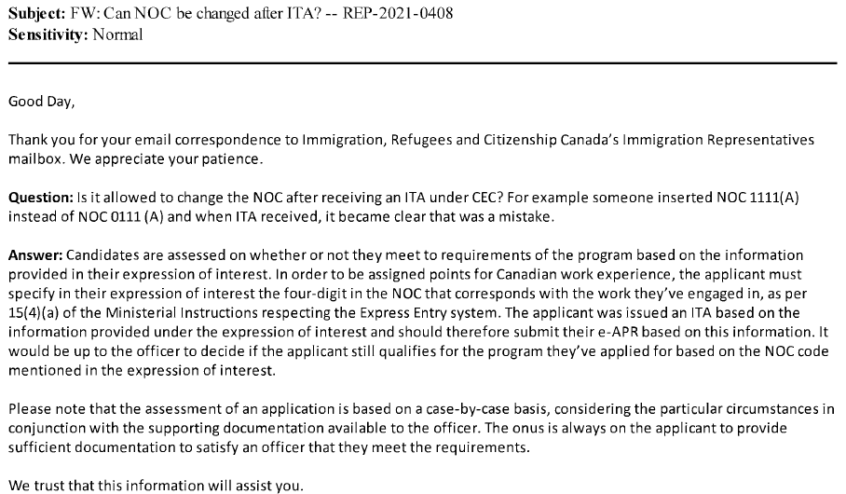
The following PDFs contain several Express Entry Q&As that were obtained through an Access to Information Act request. The topics include what documentation is required in an Express Entry application, enclosing rehabilitation applications with Express Entry, what counts as a ‘certificate of qualification’, points for skills transferability, and qualifying arranged employment. Here is more functional guidance about concurrent work experience.
Spousal Sponsorship Bar on Violent Spouses
In April the Gazette announced that a sponsorship bar would soon come into effect prohibiting individuals that have been convicted of certain offenses from sponsoring family members. One of the offenses that would result in a bar was violence against someone that the wannabe sponsor had dated, which seemed a little vague. Now that the sponsorship bar has come into effect, and Citizenship and Immigration Canada has released a detailed Operational Bulletin on the matter, lets see if the if the new rule is a little clearer. The Operational Bulletin starts by noting the gap in the law exposed by the Brar (2008 FC 1285) decision, where the Federal Court found that an individual who had murdered his brother’s wife was allowed to sponsor his own wife, as the Immigration and Refugee Protection Regulations did not specifically bar an individual who had killed a sister-in-law from sponsoring another family member. Under the new Regulations, subject to certain exceptions, anyone convicted of an indictable offense involving the use of violence punishable by a maximum term of imprisonment of at least 10 years or an attempt to commit such an offense will be barred from sponsorship. As well, subject to certain exceptions, … Read More
Leaving Canada by the end of Authorized Stay
How can temporary foreign workers show that they will leave Canada at the end of their work permit?
Non-Accompanying Family Members and Express Entry
Express Entry applicants often find it confusing to understand how declaring a family member as “non-accompanying” affects their Comprehensive Ranking System (CRS) score. It is important to know how Immigration, Refugees and Citizenship Canada (IRCC) treats non-accompanying spouses, partners, and children when calculating Express Entry points. Under Express Entry, family members include a spouse or common-law partner, dependent children, and dependent children of dependent children. Whether or not these family members will be coming to Canada with the applicant, they must be declared in the application. This is because IRCC requires all family members to be declared and examined for medical and security admissibility, even if they are not accompanying the applicant to Canada. When it comes to the CRS score, declaring a spouse or partner as “non-accompanying” has a clear impact. If an applicant has a spouse or common-law partner but declares them as non-accompanying, the applicant is assessed under the points grid used for single applicants rather than the one used for applicants with a spouse or partner. The single applicant grid generally results in a higher CRS score because it allows the applicant to receive additional points for factors such as age, education, language proficiency, and Canadian … Read More