


Connie Campbell is an immigration lawyer in Vancouver. We discuss the Federal Court decision in Talukder v. Canada (Public Safety and Emergency Preparedness), 2024 FC 1489. Is inadmissibility for membership in a terrorist organization too broad? Is the Bangladesh Nationalist Party a terrorist organization? What about Samidoun?
Landing Portal
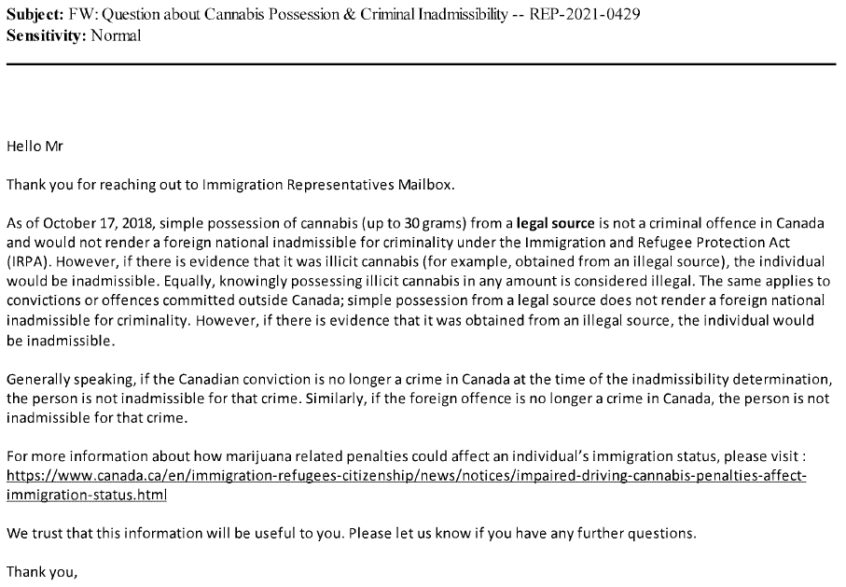
One issue that arises with the landing portal is what are the potential consequences if someone receives their eCOPR while they are temporarily outside of Canada, if they had already declared their presence in Canada through the PR confirmation portal before leaving? Here is an IMMReps response.
Temporary Resident Permits

On June 28, 2019 Immigration, Refugees and Citizenship Canada substantially changed the guidance that it provides to officers regarding the issuance of Temporary Resident Permits (“TRPs“). The biggest change was the removal of the statement that TRPs could not be issued for administrative convenience. People who do not meet the requirements of the Immigration and Refugee Protection Act (the “IRPA“), and most commonly people who are criminally inadmissible to Canada and who are not eligible to apply for rehabilitation, require TRPs in order to enter or remain in Canada.
LMIAs – Who is the Employer
There would be perhaps few things as frustrating for the potential employers of foreign workers than to go through the Labour Market Impact Assessment process only to learn that they were not considered to be an employer by the Department of Employment and Social Development Canada. According to the Temporary Foreign Worker Program manual, an employer is an entity (e.g. person, business, corporation or organization) that makes an offer of employment to one or more foreign nationals who provide labour in return for compensation for a specified period of time. The employer is generally the entity that hires, controls working conditions and remunerates the foreign national. The Manual further states: Entities Considered the Employer of a Foreign National under the TFW Program: Canadian-Based Entity A person, business, corporation or organization based in Canada that makes an offer of employment to one or more foreign nationals. Foreign-Based Entity A person, business, corporation or organization that is not based in Canada that makes an offer of employment to one or more foreign nationals to work in Canada. For identification purposes, it is strongly recommended that the foreign-based employer obtain a Canadian business number to facilitate the TFW Program’s assessment of their genuineness. … Read More
Refugee Claimants from China
China is one of the top source countries for temporary resident visa applications to China. In 2016, the number of people who applied for temporary resident visas was 492,370. Of the people who were granted visas, 822 declared refugee status. The number is unbelievably small, and represents what Immigration, Refugees and Citizenship Canada calls a risk ratio of 0.16%. I have reproduced an internal Immigration, Refugees and Citizenship Canada (“IRCC”) report titled 2016 Annual Refugee Claim Trend Analysis Summary report below. Notwithstanding this, IRCC is extremely diligent in monitoring which Chinese provinces have the highest amount of refugee claimants. This can apparently lead to refusals for borderline cases. Sample Claim Here are sample claims from China. I have posted this so that future claimants understand the different tests that must be met.
Borderlines Podcast #157 – Leaving Immigration Law, with Randall Cohn
Randall Cohn, an immigration lawyer in Vancouver, joins to discuss his reasons for leaving the Canadian immigration law practice area.
Explanation of the H&C Bars
The purpose of this blog post is to provide an overview of the changes to Humanitarian & Compassionate Applications (“H&C“) resulting from the Balanced Refugee Reform Act and the Protecting Canada’s Immigration System Act which are now in effect. In brief, there are now several restrictions on when H&C applications can be made. Permanent Residence Applications Only Perhaps most importantly, section 25 of the Immigration and Refugee Protection Act now states: Subject to subsection (1.2), the Minister must, on request of a foreign national in Canada who applies for permanent resident status and who is inadmissible or does not meet the requirements of this Act, and may, on request of a foreign national outside Canada who applies for a permanent resident visa, examine the circumstances concerning the foreign national and may grant the foreign national permanent resident status or an exemption from any applicable criteria or obligations of this Act if the Minister is of the opinion that it is justified by humanitarian and compassionate considerations relating to the foreign national, taking into account the best interests of a child directly affected. [Emphasis Added] As such, officers cannot consider H&C factors in temporary resident applications, including work permits, study permits, and visitor records. One Year Bar (and Five … Read More
Immigration Consequences of the Safe Streets and Communities Act
On December 5, the House of Commons passed Bill C-10, also known as the Safe Streets and Communities Act, or the Omnibus Crime Bill. Bill C-10 introduces numerous changes which will affect Canada’s immigration system: Changes to Sentencing Provisions The following table details changes to sentencing provisions which will impact admissibility to Canada. Crime Sentence Immigration Consequence Sexual Interference (touching an individual who is under the age of 16) Remains a hybrid offense with a maximum term of imprisonment of not more than 10 years. If Crown proceeds by way of indictment mandatory minimum penalty of 1 year. Conviction results in inadmissibility for serious criminality. Mandatory minimum would result in lack of appeal rights to the IAD Invitation to Sexual Touching (for an individual who is under the age of 16) Remains a hybrid offense with a maximum term of imprisonment of not more than 10 years. If Crown proceeds by way of indictment mandatory minimum penalty of 1 year. Conviction results in inadmissibility for serious criminality. Mandatory minimum would result in lack of appeal rights to the IAD Sexual Exploitation (of a young person) Remains a hybrid offense with a maximum term of imprisonment of not more than 10 … Read More
Right of Permanent Residence Fee
In Saffar v. Canada (Citizenship and Immigration), 2025 FC 645, the Federal Court ruled that it is reasonable for IRCC to refuse a permanent residence application if the applicant does not provide the Right of Permanent Residence Fee, and that IRCC does not have to inform them that the application was approved first.
Permanent Residence Training Guide
The following PDF contains several IRCC training materials. Here are more IRCC training materials.